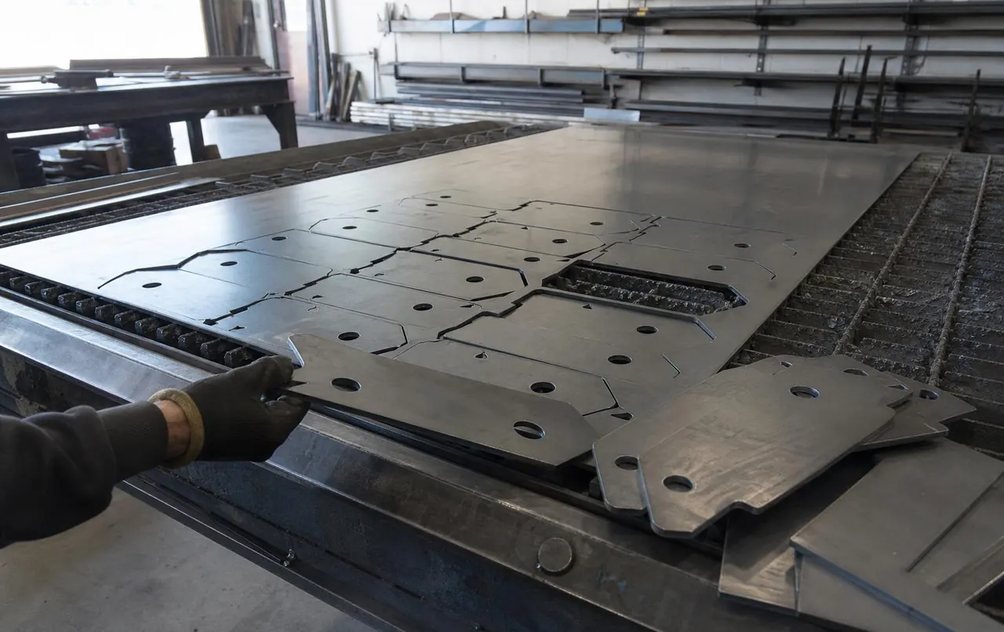
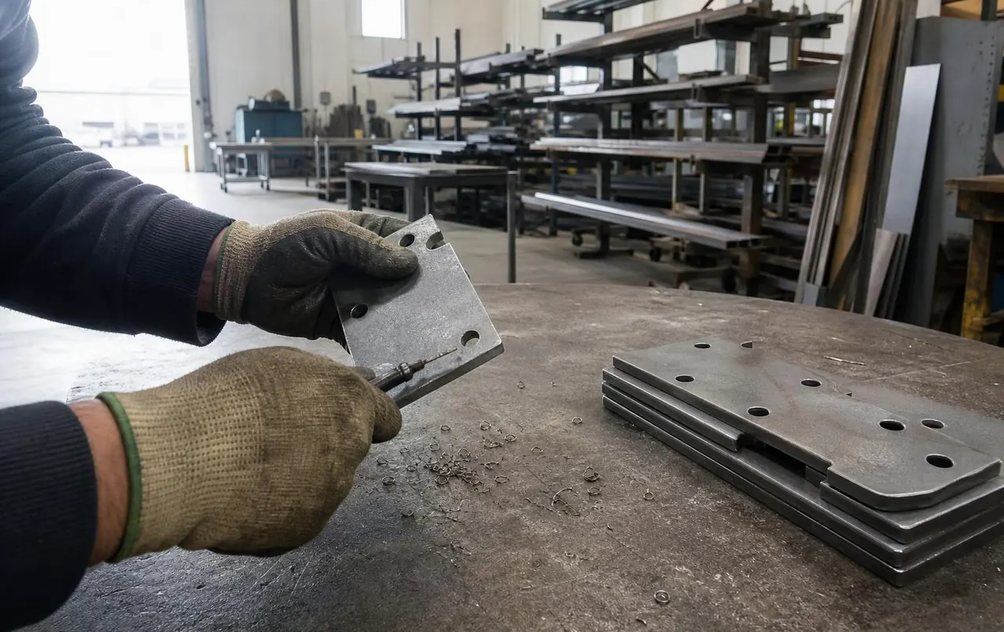
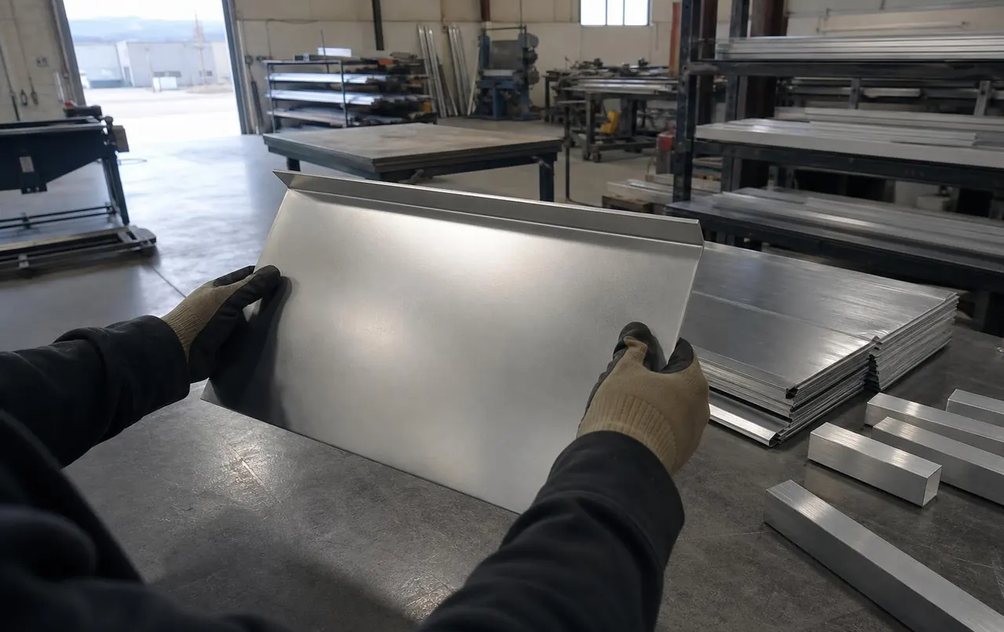
Production work is where a part stops being a question and becomes a habit. You know what it looks like, you know how it fits, and now you need it again, in a quantity, looking the same every time. Metal parts fabrication covers the whole path from flat stock to finished part: cutting, bending, drilling, machining where needed, edge work and simple assembly with hardware.
Keeping all of those steps in one shop helps the parts match. The same people who cut the blanks also bend them and break the edges, so a change at one step is caught at the next. We plan the order of operations for each part and write it down, which is what lets a second batch follow the first.
Our customers are manufacturers who need parts for their own products, equipment builders who need brackets and covers for their machines, and distributors who resell a part under their own name. Many of them started with a prototype from our shop and moved up the route as the part settled.
How a job moves through the shop
1
Approved part and drawing
We start from the drawing and, when there is one, the approved first piece.
2
Plan the operations
Cutting, forming, drilling and finishing are put in order, with stops and jigs where they help.
3
Run the batch
Parts move through each step together. The first part of each step is compared to the sample.
4
Pack and hand over
Parts are counted and packed the way you asked and set aside for your pickup.
Parts we often make this way
Equipment brackets and gussets
Cover plates and access panels
Mounting rails and strips
Sheet metal boxes and trays
Hinged doors and lids
Bolted sub-assemblies
How a batch stays consistent
Consistency comes from a few simple habits. Blanks for a batch are cut in one session from the same lot of material. Bends are made against the same stop, in the same order. Holes are drilled through a jig or from a saved program rather than marked by hand. At each step, the first part is checked against the approved sample before the rest follow.
We also write down anything that surprised us during the run, such as a sheet that sprang back more than usual or a hole that needed a different drill. Those notes go into the job folder, so the next run is a little smoother than the last.
Packing parts the way you use them
Parts that arrive in a mixed pile cost time at your end. Tell us how you want them: counted into bags of ten, stacked with paper between machined faces, grouped by assembly or labeled with your part number. We pack to that instruction and keep it with the job so a repeat run arrives the same way.
Common questions about metal parts fabrication
Which quantities do you work with?
From a handful of parts to batches of a few hundred, depending on the size of the part and the steps involved. Tell us the quantity and we will say how we would plan it.
Can you match a part we already buy elsewhere?
Often, yes. Send a sample part and any drawing you have. We review it, note any details the drawing does not show and quote from there.
Do you assemble parts too?
Simple assembly is part of the service: pressing in hardware, bolting two or three parts together and fitting covers. Larger assemblies can be discussed case by case.
Can we split an order into several lots?
Yes. Many customers order a batch and ask for it in two or three lots. We cut the material together when it makes sense and finish each lot when you need it.
Often booked together
Parts rarely need one step only. These services are the ones most often quoted alongside metal parts fabrication.
Your cookie choice. We use necessary cookies so pages and forms work. Optional analytics and advertising cookies stay off until you say yes. Cookie Policy
Cookie Choices
Choose which optional cookies this site may use. Your choice is kept for 180 days. A Global Privacy Control signal from your browser is treated as a rejection of optional cookies.
Strictly necessaryAlways on
Run the basic site functions and security, and store your cookie choice.
Count page visits in general terms. Stays off unless you switch it on.
Measure whether an ad led to a quote request. Off unless you turn it on.
Your browser sends a Global Privacy Control signal, so optional cookies stay off.